
LPG-AIR SNG SOLUTIONS
A controlled blend.
A site-specific fit.
Assess LPG-air SNG against the thermal duty, appliance requirements and value of continuity.
An LPG-vapour and air system can serve an approved application after engineering acceptance. Start by comparing direct LPG, the complete installation and the customer’s operating case.
DECISION FRAMEWORK
Make the route
explicit.
Use a defined sequence to connect the operating requirement with the evidence, responsibilities and next commitment.
- 01 /
Receive LPG
Approved storage and transfer arrangements.
- 02 /
Vaporize the liquid
Convert liquid LPG to the required vapour flow.
- 03 /
Control the air blend
Set combustion properties for the application.
- 04 /
Protect and deliver
Monitor pressure, isolate and deliver safely.
Conceptual scope sequence. The agreed assignment determines deliverables and responsibility.
THE PROCESS
From liquid LPG to a controlled gas blend
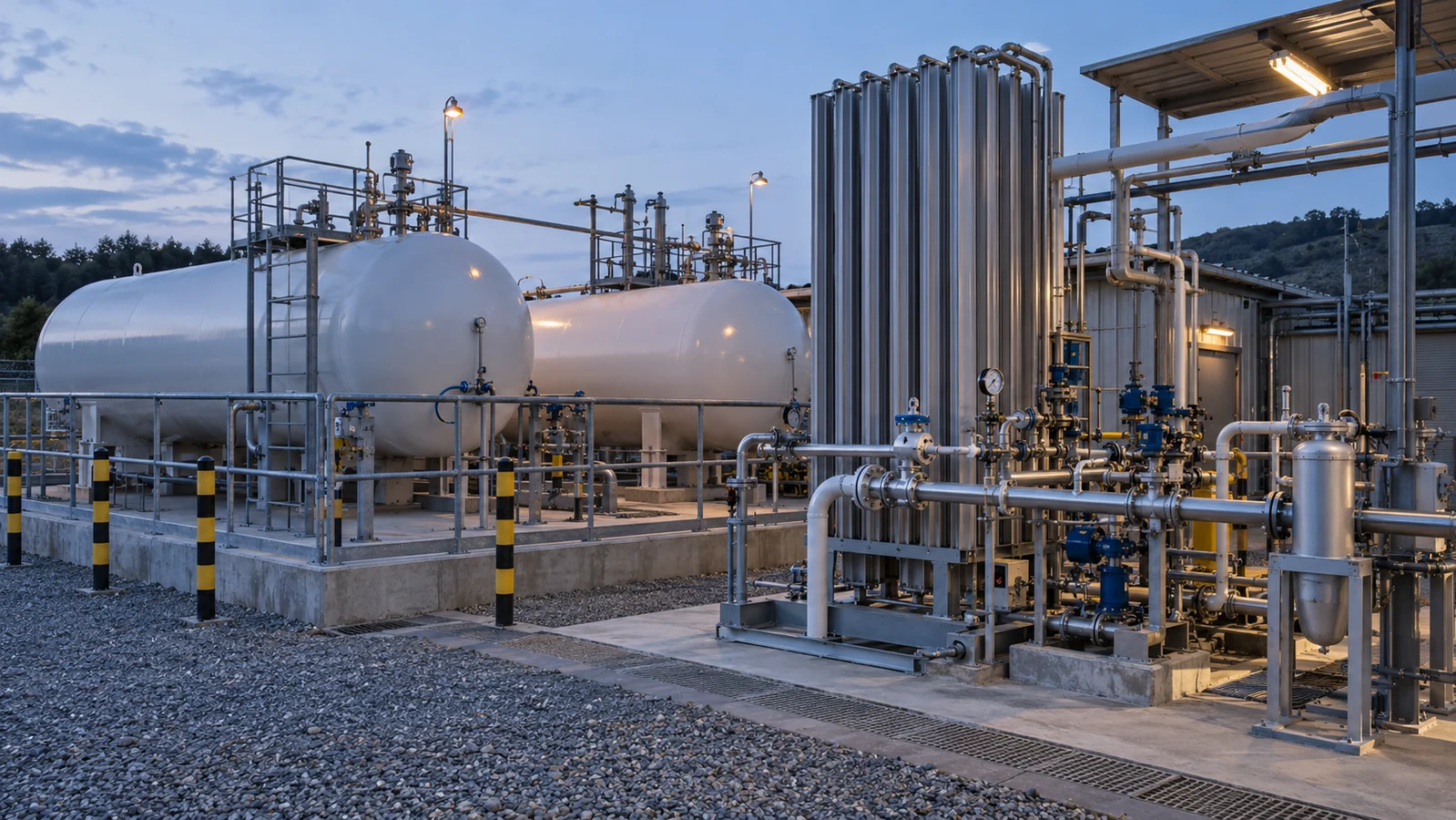
LPG storage
LPG is received and stored in a suitable installation with approved transfer and protection arrangements.
Conceptual flow only. Site approvals, equipment compatibility and engineered safety controls are required.
Blend the fuel. Do not confuse the chemistry.
Liquid LPG enters a suitable storage installation and is converted to vapour. Controlled air blending adjusts combustion characteristics, with pressure regulation, monitoring and protection supporting delivery to the approved fuel system.
SNG here is substitute natural gas produced from LPG vapour and air. It does not manufacture methane, and air adds no fuel energy.
Reference: LPG-air technology explained
Interchangeability is an engineering assessment.
The Wobbe index relates heating value to relative density and helps assess burner heat input. A match alone is not approval: fuel composition, appliance design, pressure, range, flame behaviour, emissions and protective systems also need review.
The equipment manufacturer and responsible engineer must accept the proposed duty. Boilers, ovens, dryers and furnaces may be candidates; engines, turbines and chemical feedstocks need separate specialist assessment. An industrial-header connection does not authorize public-network injection.
Reference: Gas properties and interchangeability
ILLUSTRATIVE REQUIREMENT
A compatibility review before sizing.
An illustrative two-burner thermal load prompts a check of duty, pressure, turndown and fuel acceptance; the figures do not establish system compatibility.
Illustrative planning inputs only. These values are not company results, verified site data, equipment specifications or commercial offers.
Test the simpler fuel route first.
Where burners can be converted economically, direct LPG may be the simpler operating arrangement. Added blending equipment needs a justified benefit from compatible existing thermal appliances, changeover or a shared header.
SNG does not automatically cost less than pipeline gas. Continuity can be the value proposition, but the case must use actual delivered LPG offers and site operating evidence.
The blender is one part of the installation.
Review storage, tanker access, vaporization and blending capacity, controls, shutdowns, detection, fire protection, ventilation, drainage, hazardous-area equipment and safe isolation. Auxiliary power, metering, operation and maintenance also belong in the scope.
The site and design require applicable Bangladesh approval and safety review. Overseas equipment certification or a supplier’s product standard does not replace local project approval.
Follow ownership and fuel risk through the contract.
A customer-owned model separates equipment funding from supply, installation and maintenance responsibility. A supplier-supported arrangement may link equipment or services to fuel purchases; compare minimum volume, indexation, exclusivity, termination and asset ownership across the contract term.
A financed or service model depends on a provider accepting the credit, economics and contractual security. Availability and terms remain subject to customer, project and provider approval.
Let the evidence determine the pilot.
Start with site and consumption evidence. Compare continued gas, direct LPG, LPG-air SNG and other feasible backups, then establish compatibility and approval needs.
Obtain proposals on a comparable basis and agree performance tests. A funded, bounded installation should proceed when the technical and commercial evidence supports it.